TL;DR – Base your ad budget on how many machines you need to fill. Skip to our Ad Spend Calculator to have it done for you.
Most powersports operators ask the same question at some point: “How much should we be spending on ads?” The problem is, most of the answers floating around have nothing to do with machines.
You’ll hear percentages of revenue. You’ll hear random starting numbers. You’ll hear what “most businesses” spend. None of that tells you what your operation actually needs.
There is a clear path to setting your digital advertising budget. And it does not start with platforms, CPC, or return on ad spend. It starts with something far simpler.
Unused machines.
Marketing should fill empty spots on your calendar. Not operate in the dark. Not chase vanity metrics. Not create demand where you are already full.
When you base ad spend on machine utilization, the numbers stop feeling arbitrary. They start feeling controlled. And once you see the map clearly, it becomes much easier to follow.
What to spend on ads should start with your machines
Before you talk about CPC, ROAS, Facebook vs Google vs YouTube, or what your ads should look like, you need to look at something simpler.
How many machines can you run per day? How many days are you operating? How many of those spots are already full without ads?
If you have 12 machines running 5 days a week, that is 60 potential bookings.
If weekends are already full and weekdays are light, your ad budget should focus only on weekday capacity.
That is the entire logic behind this capacity-based approach. It forces you to work backward from real availability instead of guessing a number that “feels right.”
Don’t make this mistake
Here is what usually happens. An operator decides to “try ads.” They pick a number that feels manageable. Maybe $500. Maybe $1,000. They run ads for a month. Some bookings come in. It is hard to tell if it worked.
Why?
Because there was no defined gap. No target number of bookings. No utilization goal.
When you start with machine utilization instead, the conversation changes. Ads become a tool to fill empty spots, not a gamble to “see what happens.”
The machine utilization framework
Here is the exact framework we use to determine how much should be spent on ads:
Step 1: Define your real capacity
Start with simple math:
Machines available per day _____
Operating days per week _____
Maximum possible bookings per week _____
That number is your ceiling. It is not a revenue dream. It is physical capacity.
Step 2: Separate peak from non-peak
If weekends and holidays are already full, ads should not focus there.
You are not trying to create demand that already exists. You are trying to fill unused capacity.
Most operators overspend because they advertise across the entire week instead of focusing on the days that actually need help.
Ad costs also tend to rise during peak demand windows because competition increases. This is another reason to focus spend where capacity actually exists, not where demand is already strong.
Step 3: Subtract organic bookings
How many bookings are you already getting without ads?
Subtract that from your overall capacity.
What remains is your real booking gap, or “capacity” that needs to be filled.
Step 4: Determine how many bookings you actually need
If you have 15 open weekday slots per week and organic demand fills 6 of them, ads only need to produce 9 bookings.
Not 50. Not “as many as possible.” Just 9.
That is controlled growth.
Step 5: Apply a target cost per booking
Once you know how many bookings you need, multiply by your realistic cost per booking.
If your target CPA is $40 and you need 9 bookings per week, that is $360 per week. That becomes your weekly ad spend target. Multiply by four for monthly planning.
Now you are not guessing. You are allocating based on machines.
If you have no idea what your target cost per booking should be, it can vary widely based on location, seasonality, competition, and advertising channel, but across powersports rentals we typically see averages land somewhere in the $30 to $70 range, depending on market intensity and booking value.
Step 6: Snapshot revenue and return
Take your average booking value and multiply it by the bookings ads are expected to produce.
Now you can see projected revenue clearly.
To calculate ROAS (return on ad spend), divide the total revenue from ad-generated bookings by your total ad spend. If you generate $6,000 in bookings from $1,000 in ad spend, that is a 6x ROAS.
Remember, ROAS is based on gross revenue, but what ultimately matters is margin. If your average booking nets 50 percent after hard costs, a 4x ROAS may be healthy, while a 2x ROAS might not be sustainable. Always sanity-check ROAS against your real profitability.
How to scale ad spend responsibly
Another big mistake we typically see is going from zero to full throttle, so to speak, wasting money especially in the beginning.
Instead of just landing on a budget number and spending that every single month for the entire season, think in phases:
Phase 1 is proof and optimization. Run at roughly 40 to 50 percent of planned spend to validate demand and stabilize cost per booking. This is where you test targeting, creative, and channel mix before committing to your full budget.
Phase 2 is a utilization push. Once tested, increase toward full planned spend to fill your remaining capacity.
Phase 3 is controlled growth. Only scale when cost per booking is stable and machines can support more volume, or – best case scenario – you’re ready to purchase and fill more machines.
This approach protects margin and prevents wasted ad spend.
About that “sticker shock”
Now let’s address something real. When operators run the numbers honestly, the required ad spend can feel high. There is often a moment of pause. “Wait. That is what we should be spending?” Or, “there’s no way we can spend that much.”
If this feels high, remember: consistent bookings require consistent visibility. You can spend less, just expect fewer bookings. An alternative is to start out with a smaller budget, then reinvest your returns to scale up to this plan.
That is not pressure. That is math. If you only fund half the booking gap, expect half the bookings. That is not failure. It is proportional input and output. The key here is clarity.
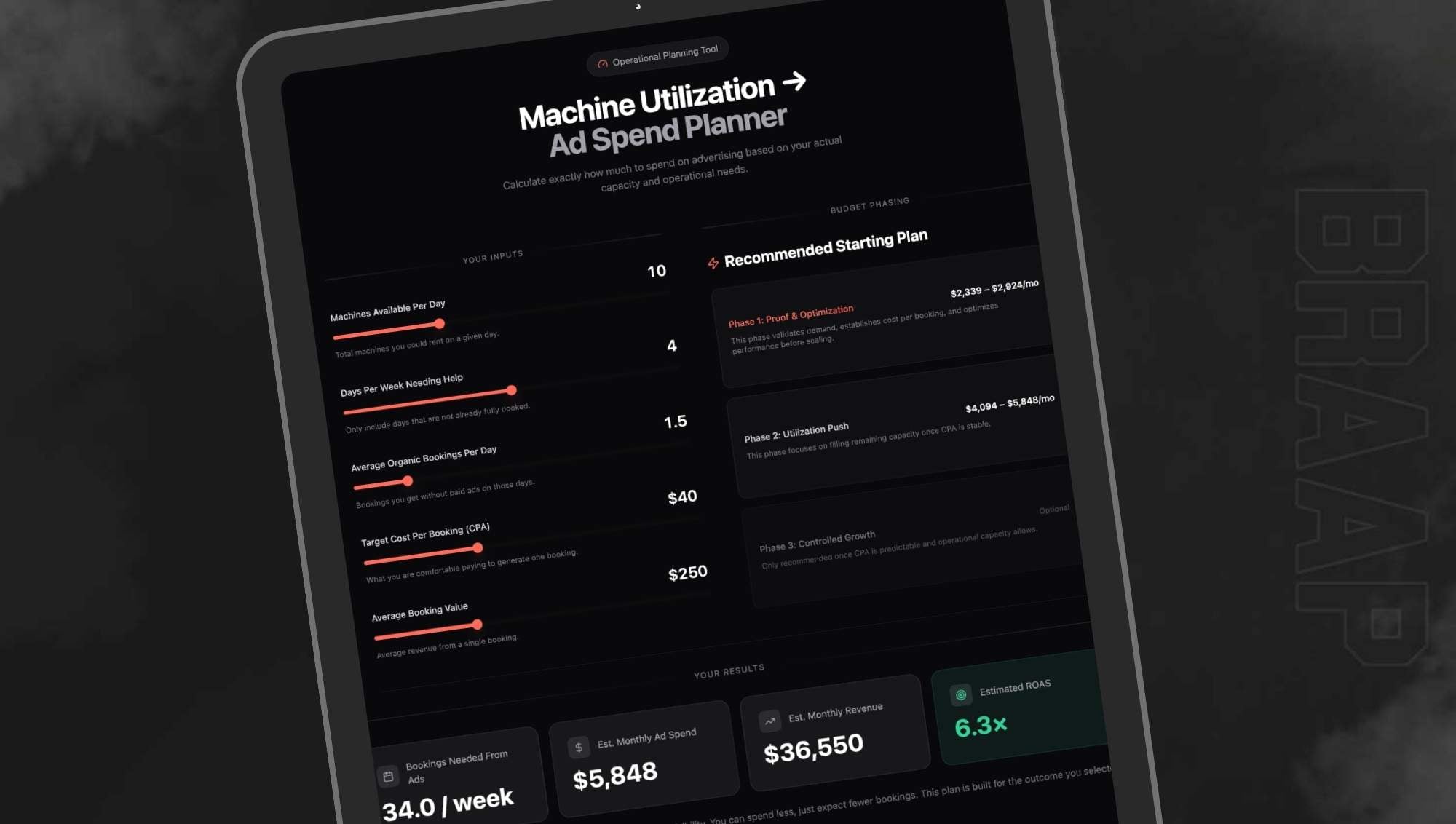
Why we built the Ad Spend Calculator
We kept seeing two extremes. Operators underspend and stall. Or they overspend without a utilization plan and feel exposed.
So we built the Ad Spend Calculator to work directly off this machine-based logic.
You plug in your number of machines, operating days, organic bookings, and target cost per booking.
It shows you exactly what to spend on ads based on your machine capacity.
Not emotionally. Logically. You can run it here.
Advertising should fill empty slots, period
Ad spend should solve one problem: filling empty machines. If you do not know your real booking gap, you do not know your real budget. Once you do, ad spend becomes predictable. Controlled. Profitable.
This machine-based framework is built directly into our Seasonal Surge System. We align spend with real capacity, demand cycles, and booking gaps so growth stays grounded.
When you follow a clear path instead of guessing, marketing stops feeling risky. It becomes a clear path.
Marketing works best when it fills machines that would otherwise sit idle. That is the entire point.
If you would rather not build the map and run the numbers yourself, that is exactly what we do. At BRAAP Digital, we help powersports rental operators align ad spend with real machine capacity so growth stays controlled and profitable. If you want a clear plan tied to utilization, not guesswork, let’s build it together.